
The Imperial Treasury at Topkapi Palace

The Imperial Treasury is located in the Third Courtyard and contains four rooms of extraordinary jewelled objects, ceremonial weapons, thrones, and decorative arts accumulated over five Ottoman centuries. The headline objects are the Topkapi Dagger and the Spoonmaker’s Diamond. Allow 35–45 minutes. Photography is permitted; flash is prohibited.
The Imperial Treasury at Topkapi Palace is one of the great treasure collections of the world — and unlike many similarly described institutions, it genuinely earns that description. Accumulated over five centuries by the Ottoman sultans and their court, it contains thousands of objects of extraordinary craftsmanship: jewelled daggers and swords, gem-encrusted thrones, golden ewers and cups, ceremonial armour, robes of honour, and some of the largest and finest precious stones on public display anywhere on earth.
For most visitors, the Treasury is the defining experience of a Topkapi Palace visit — the room containing the Topkapi Dagger and the Spoonmaker’s Diamond is consistently the most crowded and most photographed space in the entire palace. Understanding what you are looking at before you arrive, and knowing how to make the most of the experience, transforms this from a dazzling spectacle into something more meaningful.
A Brief History of the Treasury
The Imperial Treasury — Hazine-i Hümayun — was the repository of the Ottoman dynasty’s accumulated wealth. Unlike European royal treasuries that functioned primarily as financial reserves, the Ottoman Treasury was as much a statement of imperial prestige and aesthetic achievement as it was a store of monetary value. Objects entered the collection as diplomatic gifts from foreign rulers, as spoils of military conquest, as the products of the palace’s own imperial workshops (the Ehl-i Hiref), and as commissions from the sultan’s personal patronage.
The collection spans from the 15th century under Mehmed II to the 19th century under the last Ottoman sultans, reflecting the evolving tastes of the court — from the restrained elegance of early Ottoman goldsmithing to the Baroque-influenced decorative excess of the 18th century. The result is not a single coherent artistic vision but a layered accumulation of several hundred years of Ottoman imperial culture at its most opulent.
The Four Rooms of the Treasury
The Treasury is spread across four interconnecting rooms, each containing different categories of objects. Most visitors move through in order — the fourth room, containing the Topkapi Dagger and Spoonmaker’s Diamond, is typically the most congested.
Room One — Armour, Shields & Ceremonial Weapons
The first room sets the tone for the Treasury with an extraordinary display of Ottoman military craftsmanship: jewelled swords and daggers, ceremonial bows and arrows, shields inlaid with gold and precious stones, and armour that combines functional protection with extraordinary decorative ambition. Key objects include the sword of Sultan Suleiman the Magnificent — a masterwork of 16th-century Ottoman goldsmithing — and the jewelled armour of various sultans, where chainmail and plate are interwoven with enamel, rubies, and emeralds.
The weapons in the Treasury were not primarily functional — they were ceremonial objects whose purpose was to embody the sultan’s divine mandate and military prestige. The craftsmanship of the palace workshops (the Ehl-i Hiref) that produced them is in many cases technically unsurpassed in the history of metalworking.
Room Two — Thrones, Gifts & Imperial Regalia
The second room displays a succession of Ottoman thrones alongside the accumulated diplomatic gifts that arrived at the Sublime Porte from rulers across Eurasia. The Throne of Shah Ismail — captured from the Safavid ruler after the Battle of Chaldiran in 1514 — is the oldest throne in the collection, its simple wooden construction inlaid with mother of pearl and precious stones. The Indian Throne, covered in gold and studded with rubies, emeralds, and diamonds, exemplifies the later taste for overwhelming opulence.
The diplomatic gifts in this room span an extraordinary geographic range — Chinese porcelain, Indian jade objects, Central Asian metalwork, Egyptian crystal vessels — each one representing a moment of diplomatic contact between the Ottoman court and the wider world of the 15th through 19th centuries.
Room Three — Goldwork, Enamelwork & Decorative Arts
The third room concentrates on the goldsmithing and enamelwork produced by or for the Ottoman court — jewelled ewers, golden cups and dishes, incense burners, candlesticks, and decorative boxes. This room gives the clearest picture of the technical sophistication of the palace workshops — the quality of the stone-setting, the precision of the enamel work, and the formal inventiveness of the designs are remarkable even when compared to the finest European court goldsmiths of the same periods.
Room Four — The Topkapi Dagger & The Spoonmaker’s Diamond
The fourth and final room of the Treasury is where most visitors spend the most time — and understandably so. It contains the two most famous objects in the palace and two of the most celebrated objects in any museum collection in the world.
The Topkapi Dagger
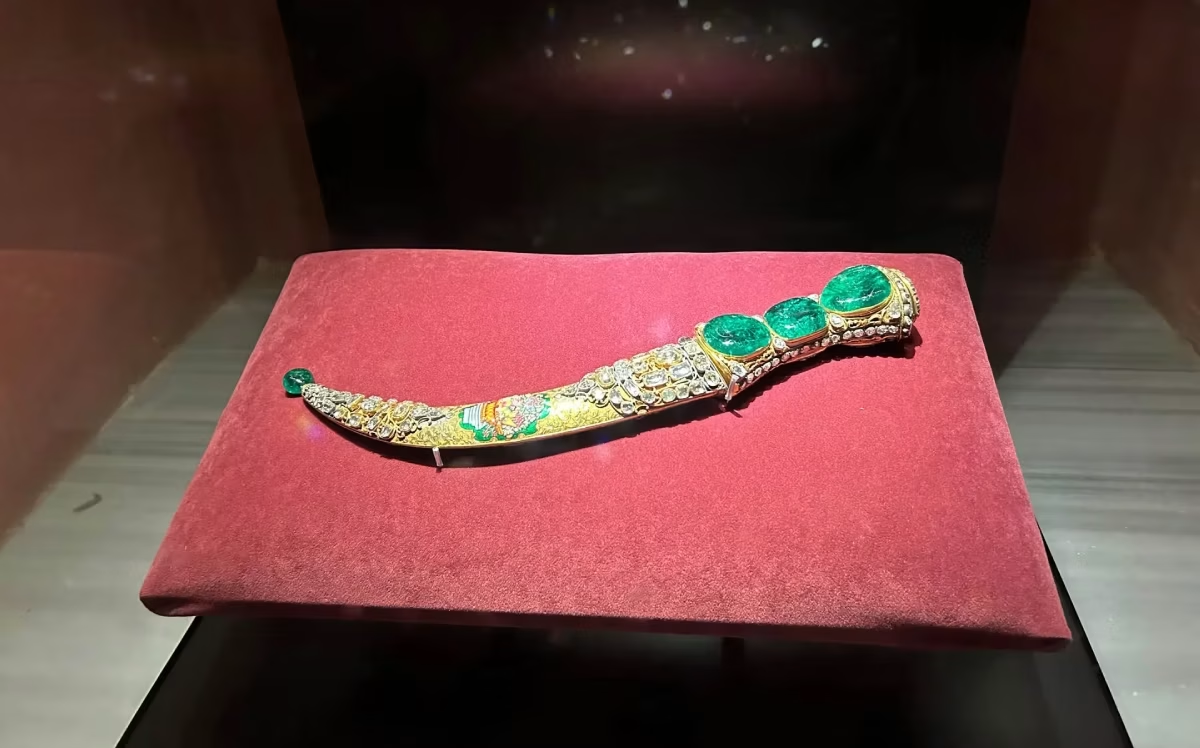
The Topkapi Dagger (Topkapı Hançeri) is the single most iconic object in the palace and one of the most recognisable artefacts of Ottoman culture worldwide. Made in 1747 under Sultan Mahmud I, it was originally commissioned as a diplomatic gift intended for the Persian ruler Nadir Shah — but Nadir Shah was assassinated before it could be delivered, and the dagger was returned to the palace, where it has remained ever since.
The dagger’s handle is set with three enormous emeralds — the largest weighing approximately 5 centimetres across — surrounded by diamonds and topped with a small watch concealed within the pommel, also set with diamonds. The blade is Damascus steel, and the scabbard is decorated with a further field of emeralds and gold. The combination of scale, material quality, and extraordinary craftsmanship places it among the finest examples of Ottoman jewellery-making ever produced.
It became internationally famous after the 1964 film “Topkapi,” directed by Jules Dassin, which was based on Eric Ambler’s novel “The Light of Day” and centred on a fictional plot to steal the dagger. The film — a caper comedy with an all-star cast — introduced the object to a global audience who had no prior knowledge of the palace or its collection.
Photography: The Topkapi Dagger is fully photographable. Flash is prohibited. The dagger is displayed in a well-lit case at roughly eye level, and close-up photography with a smartphone through the glass produces good results. The most common challenge is crowd management — arrive early in the day or late afternoon (after 16:00 in summer) for the clearest access. See our best time to visit guide for timing advice.
The Spoonmaker’s Diamond
The Spoonmaker’s Diamond — Kaşıkçı Elması in Turkish — is an 86-carat pear-shaped diamond, one of the largest cut diamonds on public display anywhere in the world, and an object with a sufficiently improbable history to have generated multiple competing legends about its origin.
The most commonly repeated story — certainly apocryphal but irresistibly appealing — is that the diamond was found by a poor man on an Istanbul rubbish heap who did not recognise it for what it was, and traded it to a spoon-maker for three wooden spoons, giving it the name it retains to this day. The more historically verifiable account is that the diamond first appears in Ottoman treasury records in the late 18th century, and that it was probably acquired through trade or as a diplomatic gift rather than found in a refuse pile.
The diamond is displayed surrounded by a double row of 49 smaller diamonds set in silver, and is one of only a handful of diamonds in the world of comparable size that is regularly accessible to the public. For comparison: the Hope Diamond (45.52 carats) is in the Smithsonian Institution in Washington; the Regent Diamond (140.64 carats) is in the Louvre; the Cullinan I (530.2 carats) is in the Tower of London. The Spoonmaker’s Diamond sits comfortably in this company.
Photography: The Spoonmaker’s Diamond is fully photographable. Flash is prohibited. The diamond is displayed in a well-lit case, but the crowd around it during peak hours can make photography difficult — the same timing advice applies as for the Topkapi Dagger.
Practical Visitor Information
Location: Third Courtyard, reached through the Gate of Felicity from the Second Courtyard.
Time needed: 35–45 minutes for a thorough visit to all four rooms. Allow extra time if visiting during peak hours (10:30–15:00 in summer) when the fourth room can be very congested.
Best time to visit the Treasury: Arrive at the palace at opening time (09:00) and go directly to the Harem first, then proceed to the Treasury — by the time you finish the Harem (45–60 minutes), the Treasury should be at a moderate crowd level. Alternatively, visit after 16:00 in summer when the afternoon crowd thins. See our how long to spend guide for full itinerary options.
Audio guide: The Treasury is one of the sections best served by the audio guide app, which provides detailed commentary on the key objects in each room. Download before entering. See our audio guide review for details.
Photography rules: Photography is permitted throughout all four rooms of the Treasury. Flash photography is prohibited. Tripods and selfie sticks are not permitted in the indoor gallery spaces.
Frequently Asked Questions
What is the Topkapi Dagger made of?
The handle of the Topkapi Dagger is set with three large emeralds, surrounded by diamonds, with a small diamond-set pocket watch in the pommel. The blade is Damascus steel and the scabbard is decorated with emeralds and gold. It was made in the Ottoman court workshops in 1747.
How big is the Spoonmaker’s Diamond?
The Spoonmaker’s Diamond weighs 86 carats and is pear-shaped. It is surrounded by 49 smaller diamonds set in silver. It is one of the largest diamonds on public display in the world.
Can you photograph the Topkapi Dagger?
Yes. Photography of the Topkapi Dagger is permitted. Flash is prohibited. The dagger is displayed in a well-lit glass case at eye level, and close-up photography without flash produces good results.
Why is the Treasury so crowded?
The Treasury is the most visited section of the palace and the Topkapi Dagger and Spoonmaker’s Diamond attract particularly dense crowds in the fourth room during peak hours. Visiting early in the morning (09:00–10:30) or after 16:00 in summer significantly improves the experience.
Is a guided tour worth it for the Treasury?
Yes — a good guide provides historical and technical context for the objects that transforms the experience from visually dazzling to genuinely meaningful. The craftsmanship and the political history behind each major object are not always conveyed by signage alone. See our guided tour options.
