
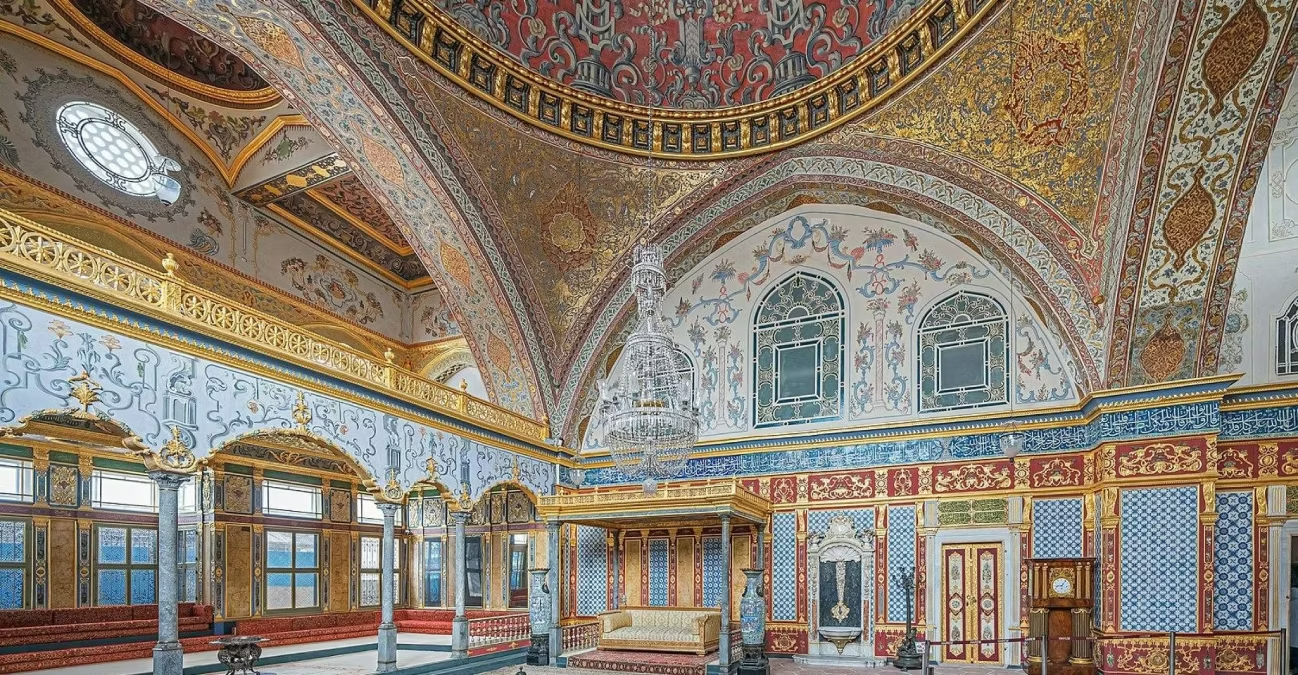
The Harem at Topkapi Palace

The Harem is included in the standard Topkapi Palace ticket since January 2024 — no separate fee applies. It contains over 300 rooms across multiple courtyards, halls, and private apartments. Allow at least 45–60 minutes; 75 minutes for a thorough visit. Enter as soon as you arrive in the Second Courtyard — the Harem gets busier as the day progresses.
Of all the sections of Topkapi Palace, the Harem is the one that most confounds first-time visitors’ expectations. The word “harem” — derived from the Arabic harām, meaning forbidden or sacred — conjures images of pure luxury and sensual indulgence, filtered through centuries of European fantasy and Orientalist misrepresentation. The reality is altogether more complex, more interesting, and ultimately more human: the Harem was simultaneously a private household, a centre of power, an educational institution, and a political arena where some of the most consequential decisions in Ottoman history were made or influenced by women who are only now beginning to receive the historical recognition they deserve.
This guide covers the Harem’s history, its most important rooms, the women and men who inhabited it, and everything you need to know for your visit.
What Was the Harem?
The Harem was the private residential quarter of the Ottoman sultan and his household. At its height in the 16th and 17th centuries, it housed several hundred people — the Valide Sultan (the sultan’s mother, who held the highest rank in the female hierarchy), the sultan’s wives (kadın efendis), his favourite concubines (hasekis), the larger community of concubines (ikbals and gedikliler), the royal princes and princesses, and the black eunuchs (Harem Ağaları) who guarded and administered it.
Far from being merely a private residence, the Harem was deeply embedded in the political life of the empire. The Valide Sultan — the reigning mother of the sultan — was in many periods the most powerful individual in the Ottoman court after the sultan himself. Through her control of the Harem’s social and political network, her influence over her son, and her ability to direct the appointments of Grand Viziers and other key officials, the Valide Sultan shaped Ottoman policy in ways that contemporary European monarchies had no equivalent for.
The period from approximately 1550 to 1656 is known among Ottoman historians as the Sultanate of Women (Kadınlar Saltanatı) — a period in which the Valide Sultans and powerful hasekis effectively governed the empire, particularly during the reigns of young or incapacitated sultans. The most famous of these women is Hürrem Sultan (known in Europe as Roxelana) — a Ruthenian-born concubine who became the legal wife of Sultan Suleiman the Magnificent, bore him six children, and whose political influence reshaped the empire’s dynastic structure in ways still debated by historians.
The Architecture & Decoration
The Harem complex was built and expanded piecemeal over more than three centuries, beginning in earnest under Sultan Suleiman the Magnificent in the 1540s when the royal household was relocated from the Old Palace to Topkapi. The result is not a single unified building but a maze-like accumulation of courtyards, corridors, apartments, and public rooms added by successive sultans according to the needs and tastes of the moment.
The architectural highlight of the Harem is its Iznik tilework — the finest collection of this extraordinarily beautiful Ottoman ceramic art found anywhere in the palace, and arguably anywhere in the world outside of the great mosques. The tiles are characterised by their vibrant cobalt blue, turquoise, and coral red on a white ground, with floral motifs — tulips, carnations, hyacinths, and roses — rendered with extraordinary precision and vitality. The tilework in the Harem reached its peak quality in the late 16th century under Murat III, and the rooms from this period are among the most beautiful interior spaces in Ottoman architecture.
The Most Important Rooms
The Courtyard of the Black Eunuchs (Harem Ağaları Taşlığı)
The first major space entered on the Harem tour is the Courtyard of the Black Eunuchs — the domain of the Harem Ağası (Chief Black Eunuch), one of the most powerful officials in the Ottoman court. The black eunuchs controlled all access to the Harem, managed its internal administration, carried messages between the Harem and the outside world, and wielded considerable political influence in their own right. The courtyard is flanked by their dormitories and the rooms of the Harem school where young concubines were educated in Ottoman language, music, etiquette, and Islamic practice.
The Courtyard of the Concubines (Cariyeler Taşlığı)
Beyond the eunuchs’ domain lies the Courtyard of the Concubines — the communal living area of the general concubine population. The concubines who entered the Harem were predominantly enslaved women from territories across the empire and beyond, converted to Islam and educated in Ottoman court culture. Most spent their years in the Harem in relative comfort but without ever meeting the sultan — rising through the hierarchy required catching his attention and bearing him children.
The Apartments of the Valide Sultan
The most spacious and lavishly decorated private apartments in the Harem belonged to the Valide Sultan — the sultan’s mother. Her rooms were positioned to give her maximum oversight of the Harem’s internal life and direct access to her son. The scale and quality of the decorations in these rooms reflect the extraordinary power the Valide Sultan commanded — in some periods she was effectively the regent of the empire.
The Privy Chamber of Murad III
The Privy Chamber of Murad III (1574–1595) is widely considered the finest room in the entire Harem and one of the great interiors of Ottoman architecture. Built in 1578, it features floor-to-ceiling Iznik tile panels of exceptional quality, a magnificent bronze fireplace, a domed ceiling with gilded stalactite decoration, and a central marble fountain whose sound — deliberately incorporated into the room’s design — masked private conversations from potential eavesdroppers. The room is a masterwork of late 16th-century Ottoman design and alone justifies the Harem entry.
The Imperial Hall (Hünkâr Sofası)
The Imperial Hall is the largest single room in the Harem — the sultan’s reception and entertainment space within the private quarters. It was here that the sultan held private entertainments, received guests who had been admitted to the inner sanctum, and spent social time with the women of the Harem. The room was substantially rebuilt in the Baroque style in the 18th century, giving it a rather different character from the 16th-century rooms — the gilded woodwork and European-influenced decoration reflect the later Ottoman taste for Western architectural motifs.
The Twin Kiosk / Crown Prince Apartments (Veliaht Daireleri)
The apartments of the crown prince — the heir to the throne — are among the most visually striking spaces in the Harem, notable for their exceptional tile panels and the intimacy of their scale. The crown prince was confined to the Harem’s “kafes” (cage) system in later periods — kept in comfortable but restricted quarters until his accession to the throne, a practice designed to prevent fratricide but which also meant that some sultans reached the throne having spent decades in near-total isolation.
Practical Information for Visiting the Harem
Ticket: The Harem is included in the standard Topkapi Palace ticket since January 2024. No additional fee applies.
When to visit: Go to the Harem first, as soon as you enter the Second Courtyard through the Gate of Salutation. It is the section most likely to build queues during the day, and visiting early gives you the most comfortable experience. See our best time to visit guide for timing advice.
Time needed: Allow a minimum of 45 minutes. 60–75 minutes is better for a thorough visit. The Harem is larger than it appears on maps and the density of historically significant rooms rewards unhurried exploration.
Audio guide: The audio guide app covers the main Harem rooms with commentary. Download it before entering — there is no Wi-Fi inside the palace. See our audio guide review for details.
Guided tour: The Harem is the section most transformed by a knowledgeable guide — the political history, the social hierarchy, and the architectural context require explanation that signage alone does not provide. A live guided tour of the Harem is strongly recommended for first-time visitors. See our guided tour options.
Photography: Photography is permitted throughout most of the Harem. Flash photography is prohibited. The Iznik tilework in the 16th-century rooms photographs beautifully in natural and ambient light. For photo spot recommendations across the whole palace, see our Bosphorus views and photo guide.
Accessibility: The Harem is partially accessible for wheelchair users. The main courtyard and several principal rooms are reachable via flat corridors, but some sections have steps without ramp alternatives. See our accessibility guide for full details.
Frequently Asked Questions
Is the Harem included in the Topkapi Palace ticket?
Yes. Since January 2024, the Harem is included in the standard Topkapi Palace ticket. There is no longer a separate entry fee.
How long does the Harem take to visit?
Most visitors spend 45–75 minutes in the Harem. It is larger and more complex than it appears on floor plans, and the density of historically significant rooms rewards unhurried exploration. See our how long to spend guide for full visit itineraries.
Who was Roxelana (Hürrem Sultan)?
Hürrem Sultan — known in the West as Roxelana — was a Ruthenian-born enslaved woman who entered the Harem of Sultan Suleiman the Magnificent and rose to become his legal wife, the first concubine in Ottoman history to be formally married to a reigning sultan. She bore him six children and wielded extraordinary political influence, including involvement in the execution of Ibrahim Pasha (the Grand Vizier and Suleiman’s closest friend) and the displacement of Suleiman’s eldest son Şehzade Mustafa. Her rise fundamentally altered the dynamics of the Ottoman court.
What is the Sultanate of Women?
The Sultanate of Women (Kadınlar Saltanatı) is the term used by Ottoman historians for the period from approximately 1550 to 1656 during which the Valide Sultans and powerful royal women effectively governed the empire, particularly during the reigns of young, inexperienced, or incapacitated sultans. Key figures include Hürrem Sultan, Kösem Sultan, and Turhan Sultan.
How many rooms does the Harem have?
The Harem complex contains over 300 rooms spread across multiple courtyards and levels. Not all rooms are open to the public — the visitor route covers the most significant spaces, which represent the major architectural and historical highlights.
