
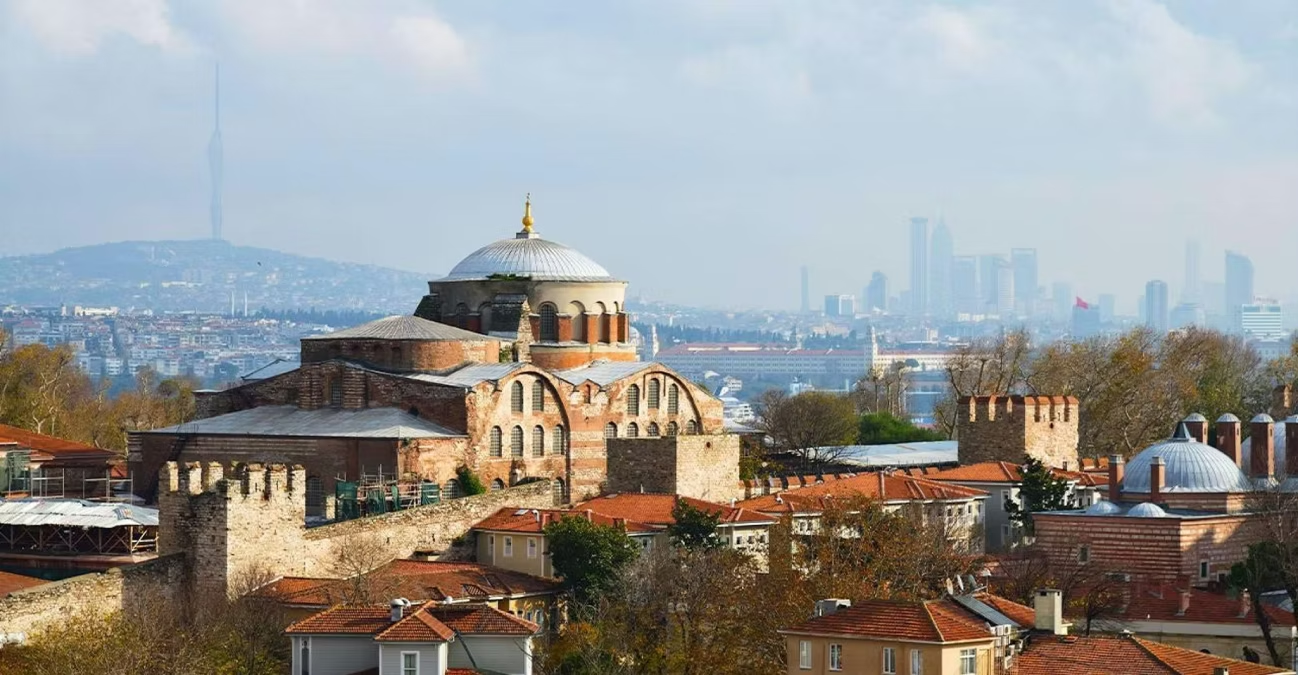
Hagia Irene: The Hidden Byzantine Church Inside Topkapi Palace

Hagia Irene (Aya İrini) is a Byzantine church located in the First Courtyard of Topkapi Palace — one of the oldest surviving churches in Istanbul, predating Hagia Sophia. It requires a separate ticket and is not included in the standard palace entry. It is occasionally closed for events and concerts. When open, allow 30–45 minutes.
Hagia Irene is one of Istanbul’s best-kept secrets — a remarkably well-preserved Byzantine church that most visitors to Topkapi Palace walk past without realising it is even there, tucked inside the First Courtyard behind the Imperial Gate. While Hagia Sophia across the square draws millions of visitors per year, Hagia Irene — which is older, architecturally almost as significant, and considerably less crowded — sees a fraction of that attention.
For visitors with a genuine interest in Byzantine history and architecture, Hagia Irene is one of the most important buildings in Istanbul. For visitors focused primarily on the Ottoman palace, it is a remarkable bonus that adds an entirely different historical layer to the Topkapi experience.
History of Hagia Irene
Hagia Irene — the Church of Holy Peace, from the Greek Εἰρήνη — is believed to be the oldest surviving Christian church in Istanbul, with origins that may predate the reign of Constantine the Great (306–337 AD). The current building dates primarily to the reign of Emperor Justinian I (527–565 AD), who rebuilt it after the Nika Revolt of 532 destroyed the earlier structure — the same building programme that also produced the current Hagia Sophia nearby.
Unlike Hagia Sophia, Hagia Irene was never converted into a mosque following the Ottoman conquest of Constantinople in 1453. Mehmed II incorporated it into the first courtyard of his new palace and used it initially as an armoury — a function it continued to serve under various guises until the 19th century. This unusual history means that Hagia Irene retains more of its original Byzantine interior fabric than Hagia Sophia: there is no Ottoman plaster covering the Byzantine mosaics (because there never was any, the interior having been used for storage rather than worship), and the original apse mosaic — a large cross on a gold ground in the aniconic tradition — is fully visible.
The building was used as a military museum and armoury through the Ottoman and early Republican periods before being opened to visitors as a museum annexe and concert venue.
What to See Inside
The Interior Space — Hagia Irene’s interior is immediately striking in its austere grandeur. Unlike Hagia Sophia’s overwhelming decorative richness, Hagia Irene is almost entirely unadorned — the brick walls are bare, the columns are plain, and the space is dominated by its architectural geometry: a central nave, side aisles, a gallery level, and a large apse. The effect is of extraordinary architectural purity — the space demonstrates how the Byzantine builders achieved the sensation of vast, soaring space with relatively simple structural means.
The Apse Mosaic — The most significant surviving decoration is the large mosaic cross on a gold ground in the conch of the apse — a rare surviving example of Byzantine aniconic art from the period before the Iconoclast controversy resolved in favour of figurative religious art. This type of non-figurative sacred imagery is rarely seen in situ anywhere in the Byzantine world.
The Synthronon — A remarkable surviving feature of the interior is the synthronon — the semicircular tiered seating for the clergy arranged around the apse, which survives almost intact. Few Byzantine churches anywhere retain this element, which gives Hagia Irene an extraordinary sense of its original liturgical function.
The Atrium — The partially surviving atrium (forecourt) to the west of the main building is visible from the First Courtyard. Byzantine churches typically featured an atrium for catechumens (those preparing for baptism), and the Hagia Irene atrium is one of the few surviving examples in Istanbul.
The Gallery Level — The upper gallery is accessible and provides an elevated view of the nave and apse that reveals the building’s proportions and structure most clearly. This is also the best position for photographing the apse mosaic.
Ticket Information
Hagia Irene is not included in the standard Topkapi Palace ticket. It requires a separate entry ticket, available at the gate of the First Courtyard. The current ticket price should be confirmed on arrival as it is updated periodically.
Important note on access: Hagia Irene is frequently used as a concert and event venue — it has exceptional acoustics and is one of Istanbul’s most prestigious concert settings. When events are scheduled, the church closes to general visitors for the day. Before planning your visit around Hagia Irene, check the current event schedule online or confirm with the palace on arrival.
Visitor Tips
Visit at the start of your Topkapi visit. Hagia Irene is located in the First Courtyard, immediately after passing through the Imperial Gate. Visiting it at the beginning of your Topkapi Palace visit — before moving through to the Gate of Salutation — makes the most logical use of the physical layout. See our how long to spend guide for how to incorporate Hagia Irene into a full visit itinerary.
Bring context. Hagia Irene rewards visitors who arrive knowing something about Byzantine architecture and the history of the early church in Constantinople. Without that context, the bare interior may seem underwhelming compared to the decorative richness of the Ottoman sections of the palace. The audio guide for Hagia Irene — if included in your ticket — provides valuable framing.
Enjoy the relative quiet. Hagia Irene sees a fraction of the visitor numbers of the main palace sections. On a typical day, you may have significant stretches of the interior almost to yourself — a remarkable luxury in one of Istanbul’s most visited historic sites.
Time needed: 30–45 minutes for a thorough visit including the gallery level.
Hagia Irene and Hagia Sophia — Key Differences
Many visitors confuse or conflate the two great Byzantine churches of Istanbul. The differences are significant:
| Hagia Irene | Hagia Sophia | |
|---|---|---|
| Location | First Courtyard, Topkapi Palace | Directly opposite Topkapi |
| Built | 4th century AD, rebuilt 537 AD | 537 AD |
| Current status | Museum / concert venue | Active mosque |
| Ticket | Separate (not in palace ticket) | Separate ticket required |
| Interior decoration | Mostly bare — aniconic mosaic cross | Byzantine mosaics, Ottoman calligraphy |
| Visitor numbers | Low — much quieter | Very high |
| Prayer times closure | No (not a mosque) | Yes — closed during prayers |
Frequently Asked Questions
Is Hagia Irene included in the Topkapi Palace ticket?
No. Hagia Irene requires a separate entry ticket, available at the gate of the First Courtyard. Confirm the current price on arrival.
Is Hagia Irene older than Hagia Sophia?
The origins of Hagia Irene predate Hagia Sophia — it may have been a Christian place of worship from as early as the 4th century AD. The current building of both churches dates primarily to the reign of Emperor Justinian I in the 6th century, though Hagia Irene’s reconstruction slightly predates the current Hagia Sophia.
Why is Hagia Irene so bare inside?
Hagia Irene was never converted to a mosque after the Ottoman conquest — instead it was used as an armoury and storage facility. Because it was not used for worship, it was never decorated with the Islamic calligraphy and alterations applied to Hagia Sophia. Its Byzantine interior fabric was simply preserved as it was, making it a rare example of an intact Byzantine church interior.
Can I visit Hagia Irene and Topkapi Palace on the same day?
Yes — Hagia Irene is located inside the First Courtyard of Topkapi Palace, so visiting both on the same day involves no additional travel. Allow an extra 45–60 minutes in your visit plan for Hagia Irene. See our how long to spend guide for full itinerary options.
