
Topkapi Palace Dress Code, Photography Rules & Etiquette

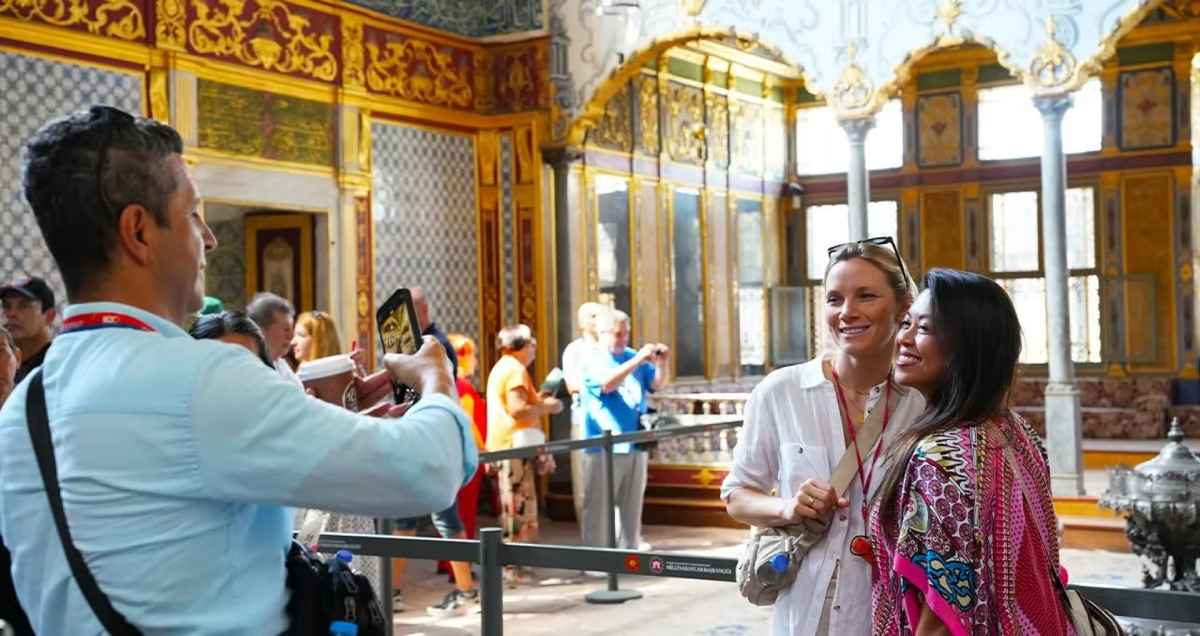
There is no strict religious dress code at Topkapi Palace — unlike the nearby Blue Mosque, head coverings and shoe removal are not required. Smart casual is appropriate. Photography is permitted in most areas but prohibited in parts of the Sacred Relics Room and restricted to no-flash in all indoor galleries. Smoking is completely banned across the entire palace grounds.
Topkapi Palace sits at an interesting intersection — it is simultaneously a major tourist attraction, one of the world’s great museum complexes, and a site of deep religious and historical significance, particularly the Sacred Relics Room which draws Muslim pilgrims from across the world. Understanding the etiquette expected of visitors — both formal rules and unwritten conventions — helps you navigate the visit respectfully and without interruption.
This guide covers the dress code, photography rules by section, smoking and vaping policy, general behaviour expectations, and a few things visitors commonly get wrong.
Dress Code at Topkapi Palace
No mandatory religious dress requirements — head coverings are not required and shoes are not removed. Smart casual is appropriate and expected. Overly revealing or beach-style clothing is out of place, particularly in the Sacred Relics Room.
Unlike the Sultan Ahmed Mosque (Blue Mosque), which is located a short walk away and requires visitors to cover their heads, shoulders, and legs, Topkapi Palace operates as a secular museum and has no mandatory religious dress code. You will not be turned away at the gate for wearing shorts or a sleeveless top.
That said, the palace — and particularly the Sacred Relics Room (Kutsal Emanetler Odası) — is a deeply significant religious and historical site. The Sacred Relics Room houses items associated with the Prophet Muhammad and the earliest caliphs, and is treated with great reverence by the many Muslim pilgrims who visit it daily. Verses from the Quran are recited continuously inside. Dressing respectfully in this section of the palace is not a rule but a matter of common courtesy.
What to wear:
- Smart casual is ideal — comfortable trousers or jeans, a t-shirt or shirt, and flat shoes
- Dresses and skirts are fine at any length, though modest lengths are more appropriate near the Sacred Relics Room
- Shoulders do not need to be covered, but a light layer is useful for the air-conditioned indoor galleries
- Flat, rubber-soled shoes are strongly recommended — the palace grounds involve extensive walking on uneven cobblestones, and heels or sandals with thin straps are genuinely uncomfortable over long distances
What to avoid:
- Swimwear, bikini tops, or beach cover-ups — inappropriate for a museum of this significance
- Very short shorts — fine at the gate but considered disrespectful in the Sacred Relics Room
- Flip-flops or thin-soled sandals — uncomfortable on cobblestones over a 3–4 hour visit
There are no clothing items available to borrow at the palace entrance (unlike some mosques where scarves are provided at the door), so if you are visiting the Blue Mosque and Topkapi Palace on the same day, dress for the mosque and you will be appropriately dressed for the palace too.
Photography Rules at Topkapi Palace
Photography is permitted in outdoor courtyards and most indoor galleries. Flash photography and tripods are prohibited throughout all indoor spaces. Photography is restricted or prohibited in parts of the Sacred Relics Room. Drone photography is not permitted.
Photography rules at Topkapi Palace are more permissive than at many comparable sites — the majority of the palace’s galleries and outdoor spaces are fully photographable. The key restrictions apply to flash use, tripods, and specific rooms within the Sacred Relics section.
Outdoor Courtyards — Photography Fully Permitted
All four courtyards, the terrace gardens of the Fourth Courtyard, and the exterior of palace buildings are freely photographable. The Bosphorus views from the Fourth Courtyard terraces are among the most photographed vistas in Istanbul — take your time here.
The Harem — Photography Permitted, No Flash
Photography is permitted throughout most of the Harem complex. Flash photography is prohibited in all rooms. The Harem’s Iznik tilework and gilded interiors photograph beautifully in natural light — the restriction is not a significant handicap with a modern smartphone camera.
The Imperial Treasury — Photography Permitted, No Flash
Photography is fully permitted inside the Imperial Treasury. The Topkapi Dagger and Spoonmaker’s Diamond are among the most photographed objects in the palace. As with the Harem, flash is prohibited. Glass cases mean some reflection on close-up shots — positioning your lens close to the glass and using ambient light gives the best results.
The Sacred Relics Room — Restricted Photography
This is the most sensitive section of the palace for photography. Photography is permitted in the outer areas of the Sacred Relics Room corridor and some adjoining spaces, but is prohibited inside the central chamber where the most sacred relics — including the mantle and sword of the Prophet Muhammad — are displayed. Signage at the entrance to each area is clear. Respect the restrictions without needing to be reminded by staff. See our Sacred Relics Room guide for what to expect inside.
The Palace Kitchens & Other Galleries — Photography Permitted, No Flash
Photography is permitted in the Palace Kitchens porcelain and silverware galleries, in the Imperial Collections rooms displaying miniatures and manuscripts, and in the Armory. Flash photography is prohibited throughout.
Photography Rules Summary Table
| Area | Photography | Flash | Tripod |
|---|---|---|---|
| All outdoor courtyards | ✓ Permitted | ✓ Permitted | ✗ Not permitted |
| Harem | ✓ Permitted | ✗ Prohibited | ✗ Not permitted |
| Imperial Treasury | ✓ Permitted | ✗ Prohibited | ✗ Not permitted |
| Sacred Relics Room (outer) | ✓ Permitted | ✗ Prohibited | ✗ Not permitted |
| Sacred Relics Room (inner chamber) | ✗ Prohibited | ✗ Prohibited | ✗ Not permitted |
| Palace Kitchens | ✓ Permitted | ✗ Prohibited | ✗ Not permitted |
| Imperial Collections | ✓ Permitted | ✗ Prohibited | ✗ Not permitted |
Drone photography is not permitted anywhere within the palace grounds or airspace above the complex.
Video recording follows the same rules as photography — permitted where photography is permitted, prohibited where photography is prohibited.
Smoking & Vaping Policy
Smoking — including electronic cigarettes and vaping devices — is strictly prohibited throughout the entire palace grounds, both indoors and outdoors. This is enforced by Turkish Law No. 4207, in force since November 1996. Violation can result in removal from the premises.
This is one of the strictest no-smoking policies in Istanbul’s major attractions, and it applies without exception to every part of the palace — courtyards, gardens, galleries, and corridors alike. Unlike some outdoor museum sites where smoking in garden areas is tolerated, Topkapi Palace enforces its no-smoking rule outdoors as well as indoors. Palace staff actively patrol and will ask persistent smokers to leave.
If you smoke, plan to do so outside the palace grounds before entering through the Imperial Gate and after exiting. There are no designated smoking areas within the complex.
General Behaviour & Etiquette
Noise levels in the Sacred Relics Room. The Sacred Relics Room is treated with the same reverence as a place of active worship by many of its visitors. Verses from the Quran are played continuously inside. Keeping your voice low and your phone on silent in this section is the appropriate standard of behaviour, regardless of your own religious background.
Queuing at bottlenecks. The Harem corridor, the Treasury entrance, and the security gate at the Imperial Gate are the three main bottleneck points where queues form. Patience and orderly queuing are expected. Attempting to push to the front of a queue is not tolerated by other visitors or palace staff.
Touching exhibits. Display cases in the Treasury and other galleries exist to protect the exhibits — do not attempt to touch or tap the glass. Objects in the palace kitchens and courtyard areas that appear to be structural elements (columns, stonework, fountains) are historical artefacts and should not be climbed on or touched.
Supervision of children. The palace is suitable for children and many families visit. The courtyards provide good space for children to move around, but the narrow corridors of the Harem and the crowd-heavy Treasury require close supervision. See our first-timer tips for general advice on visiting with children.
Eating and drinking inside galleries. Food is not permitted inside any of the indoor gallery spaces. Water in a sealed bottle is generally fine to carry. The Konyalı café in the Fourth Courtyard is the designated place for food and drink during your visit. See our dining and facilities guide for details.
Frequently Asked Questions
Do I need to cover my head at Topkapi Palace?
No. Topkapi Palace is a secular museum and does not require head coverings. This distinguishes it from the nearby Blue Mosque, which does require women to cover their hair. You may choose to cover your head out of personal respect in the Sacred Relics Room, and many visitors do, but it is not a requirement.
Do I need to remove my shoes at Topkapi Palace?
No. Unlike mosques, Topkapi Palace does not require shoe removal anywhere on the premises.
Can I take photos of the Topkapi Dagger?
Yes — photography of the Topkapi Dagger in the Imperial Treasury is permitted. Flash is not allowed, but the dagger is well-lit and photographs clearly with a smartphone. It is one of the most photographed objects in the palace.
Is the dress code different for the Harem?
No. The same smart casual standard applies throughout the palace, including the Harem. There is no additional dress requirement to enter the Harem section.
Can I bring a selfie stick?
Selfie sticks are technically in the category of tripods and extended camera support, and are therefore not permitted in indoor gallery spaces. They are generally tolerated in outdoor courtyards. Using one inside the Harem or Treasury would be considered disruptive given the narrow spaces and crowded conditions.
