
Topkapi Palace Accessibility Guide

Topkapi Palace is partially accessible for wheelchair users and visitors with limited mobility. The main entrance has ramp access, and several courtyard areas are navigable on flat ground. However, much of the complex involves uneven cobblestone surfaces, narrow corridors in the Harem, and some sections with steps that have no ramp alternative. Advance planning is essential for visitors with mobility needs.
Topkapi Palace is a 560-year-old Ottoman imperial complex, and like many historic sites of its age, it was not designed with modern accessibility standards in mind. The palace does make genuine efforts to accommodate visitors with disabilities — ramps have been added at key entry points, and some pathways have been improved — but the reality is that the site presents significant challenges for wheelchair users and visitors with limited mobility.
This guide gives you an honest, detailed picture of what is and is not accessible, so you can plan a comfortable and rewarding visit.
The Honest Overview
Topkapi Palace is a site where mobility challenges are real and unavoidable. The cobblestone surfaces that cover the majority of the palace grounds are uneven and slippery when wet. The distance between sections is substantial — getting from the Imperial Gate to the Fourth Courtyard involves a walk of well over half a kilometre in total. The Harem, while partially accessible in its main corridors, involves some steep steps and narrow passageways that are difficult or impossible to navigate in a wheelchair.
That said, the most significant attractions — the Imperial Treasury, the Sacred Relics Room, the Fourth Courtyard terraces, and much of the Harem — are reachable with varying degrees of assistance. Visitors with limited mobility who are mobile on flat ground with walking aids can navigate a meaningful portion of the palace. Full wheelchair users will need assistance at specific points and may not be able to access all sections.
If you are visiting with a wheelchair user or have significant mobility limitations, we recommend contacting the palace directly before your visit at +90 (212) 512 0480 to confirm current accessibility conditions — the palace is an ongoing restoration project and conditions can change.
Getting to the Palace — Accessibility at the Entrance
Arriving by tram: The T1 tram’s Sultanahmet and Gülhane stops are both street-level and accessible. The walk from Sultanahmet stop to the Imperial Gate is approximately 3 minutes on a mostly flat pavement with some minor uneven sections.
The Imperial Gate (main entrance): The main entrance has a ramp alongside the steps leading through the gate, allowing wheelchair access to the First Courtyard. The security screening area at the gate has accessible lanes — staff are generally helpful at directing visitors with mobility needs through the process.
Alternative Gülhane entrance: The Gülhane Park entrance on the northern side of the palace is an alternative access point. The path through the park is on a slope and involves a long walk on an inclined surface, which some wheelchair users find more challenging than the main Imperial Gate route. However, it may have shorter security queues on busy days.
Accessibility by Section
First Courtyard — Largely Accessible
The First Courtyard is a wide, open space with cobblestone surfaces that are relatively even compared to other parts of the complex. Wheelchair navigation is possible here with assistance over the cobblestones. Hagia Irene — which requires a separate ticket — has steps at its entrance and limited accessibility.
Second Courtyard — Partially Accessible
The Second Courtyard is accessible via a ramp from the Gate of Salutation. The courtyard itself is a large open cobblestone space that is navigable for wheelchairs with assistance. The Palace Kitchens galleries have accessible entrances, though the interior spaces are somewhat narrow in sections.
The Harem entrance in the Second Courtyard is accessible at the point of entry, but the interior presents challenges — see the Harem section below.
The Harem — Partially Accessible
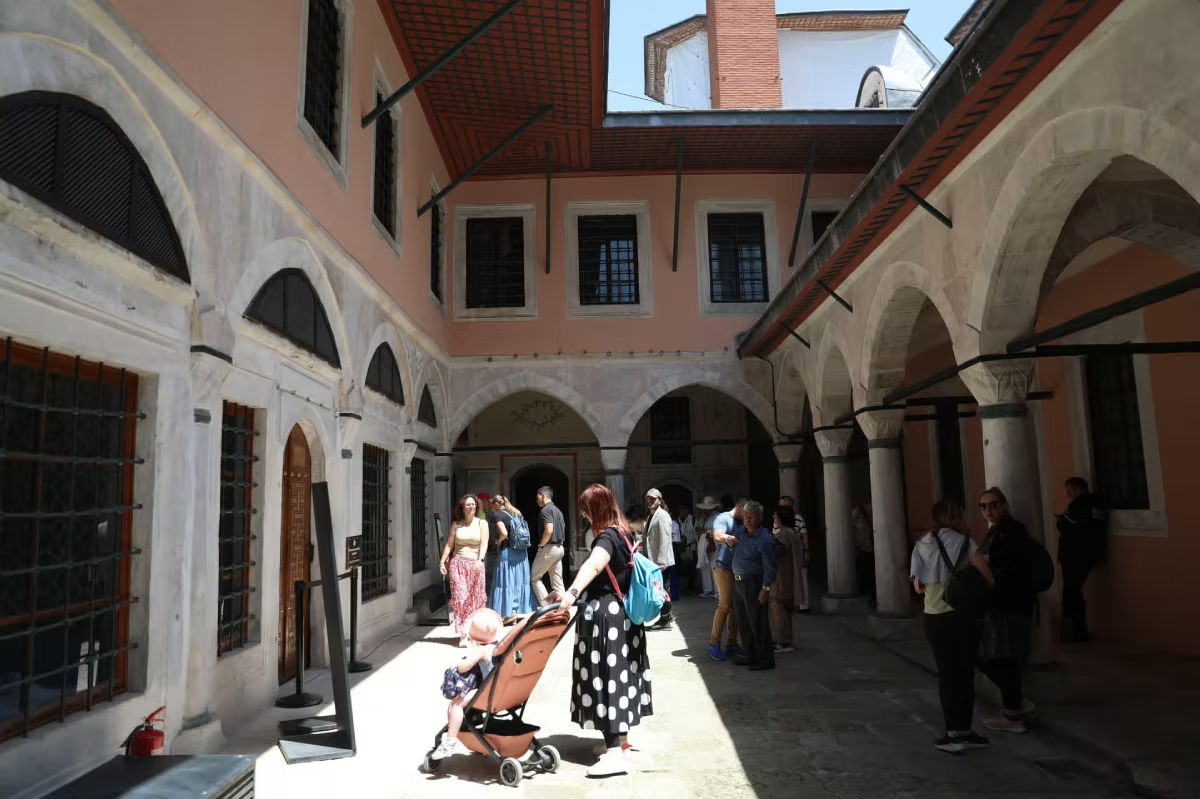
The Harem is the most complex section of the palace for visitors with mobility needs. The main Harem courtyard and several of the principal rooms — including the Imperial Hall — are reachable along relatively flat corridors. However, parts of the Harem involve narrow passageways, uneven floors, and stepped sections without ramp alternatives. Visitors using manual wheelchairs will need a companion to assist at several points. Not all rooms in the Harem are accessible.
Despite these challenges, much of the Harem’s most significant spaces are reachable with assistance, and the visit is worth attempting for visitors with mobility aids who are comfortable with some help navigating steps.
Third Courtyard — Accessible with Assistance
The Third Courtyard is reached through the Gate of Felicity (Bâbüssâade), which has a ramp alongside the steps. The courtyard itself is cobblestoned but relatively flat. The Imperial Treasury has an accessible entrance ramp and the interior galleries are navigable by wheelchair, though crowded conditions during peak hours can make movement difficult. The Sacred Relics Room is similarly accessible at the entrance level, with the main corridor and viewing areas reachable by wheelchair.
Fourth Courtyard — Accessible, Outstanding Views
The Fourth Courtyard is the most scenically rewarding part of the palace and is largely accessible. The terraced gardens involve some sloped pathways, but the main terrace level with the Bosphorus panorama is reachable without steps. The views over the Bosphorus and Golden Horn are among Istanbul’s finest and are fully accessible from the main terrace level.
Accessibility Summary Table
| Section | Wheelchair Accessible | Notes |
|---|---|---|
| Imperial Gate entrance | ✅ Ramp available | Staff assistance available |
| First Courtyard | ⚠️ Partial | Cobblestones — uneven surface |
| Second Courtyard | ⚠️ Partial | Ramp at Gate of Salutation |
| Palace Kitchens | ✅ Largely accessible | Some narrow interior sections |
| Harem | ⚠️ Partial | Steps in some areas — assistance needed |
| Gate of Felicity | ✅ Ramp available | Access to Third Courtyard |
| Third Courtyard | ⚠️ Partial | Cobblestones — manageable with assistance |
| Imperial Treasury | ✅ Largely accessible | Ramp at entrance |
| Sacred Relics Room | ✅ Largely accessible | Main viewing corridor accessible |
| Fourth Courtyard | ✅ Largely accessible | Main terrace level accessible |
| Hagia Irene | ❌ Steps at entrance | Limited accessibility |
Tips for Visitors with Mobility Needs
Visit in winter or early morning. Crowd levels significantly affect how navigable the palace is for wheelchair users and visitors with mobility aids. In peak summer (July–August), the narrow Harem corridors and Treasury entrance become heavily congested, making wheelchair navigation very difficult. Visiting in winter or at opening time (09:00) gives you the best conditions for comfortable movement through the palace.
Bring a companion. Even where ramps are available, the cobblestone surfaces throughout the palace grounds require assistance to navigate comfortably in a wheelchair. Visiting with a companion who can help at stepped sections and over uneven ground makes the visit significantly more manageable.
Wear appropriate footwear. For visitors with limited mobility who are walking with aids, flat rubber-soled shoes with good grip are essential. Wet cobblestones can be slippery, and thin-soled shoes provide insufficient cushioning over long distances.
Use a guided tour for better logistics. A private guided tour can be tailored to your mobility needs, focusing on accessible sections and avoiding the most challenging areas. Your guide can help navigate logistics at the entrance, security, and between sections. See our private guided tour options for what is available.
Contact the palace in advance. For the most current information about accessibility conditions — which can change as restoration and improvement works continue — contact Topkapi Palace Museum directly at +90 (212) 512 0480 or via the Turkish Ministry of Culture website. Staff can advise on specific accessibility requirements and any current closures that may affect your planned route.
Allow extra time. Navigating the cobblestone courtyards and managing steps with a wheelchair or mobility aid takes longer than a standard visit. Allow at least 30–45 minutes of extra time over the standard visit estimates. See our how long to spend guide for baseline time estimates.
Sensory & Cognitive Accessibility
Audio guides are available in up to 25 languages via smartphone app, providing detailed commentary on each section of the palace. This is valuable for visitors with visual impairments who want audio description of what they are passing through. Download the guide before entering — there is no Wi-Fi inside the palace. See our audio guide review for setup details.
For visitors with visual impairments, a live guided tour provides the most enriching experience, as a good guide can describe the visual details of the Iznik tilework, the scale of the Treasury collections, and the Bosphorus panorama in ways that the audio app does not always capture. See our guided tour options.
For visitors with cognitive or sensory sensitivities, the most challenging aspects of the palace are likely to be the crowded conditions during peak hours and the continuous Quran recitation inside the Sacred Relics Room. Visiting early in the morning on a weekday significantly reduces crowd noise and congestion. The Sacred Relics Room is a calm and reverential space outside of peak crowding periods.
Frequently Asked Questions
Is Topkapi Palace wheelchair friendly?
Partially. Key sections — the Treasury, Sacred Relics Room, and Fourth Courtyard terraces — are largely accessible with ramps and flat approach surfaces. The Harem has partial wheelchair access with assistance. The main challenge throughout the palace is the cobblestone ground surface, which requires wheelchair assistance over uneven terrain.
Are there accessible toilets at Topkapi Palace?
Yes. Accessible toilet facilities are available within the palace grounds. See our dining and facilities guide for their locations.
Can I hire a wheelchair at Topkapi Palace?
Topkapi Palace does not currently offer wheelchair hire on site. Visitors who require a wheelchair should bring their own or arrange hire from an Istanbul mobility equipment provider in advance.
Is there an accessible entrance to Topkapi Palace?
Yes. The main Imperial Gate has a ramp alongside the steps, providing wheelchair access to the First Courtyard. Staff at the security gate are available to assist visitors with mobility needs.
Is the Harem accessible for wheelchair users?
Partially. The main Harem courtyard and several principal rooms are reachable via flat corridors, but some sections involve steps without ramp alternatives. A companion to assist at these points is strongly recommended.
