
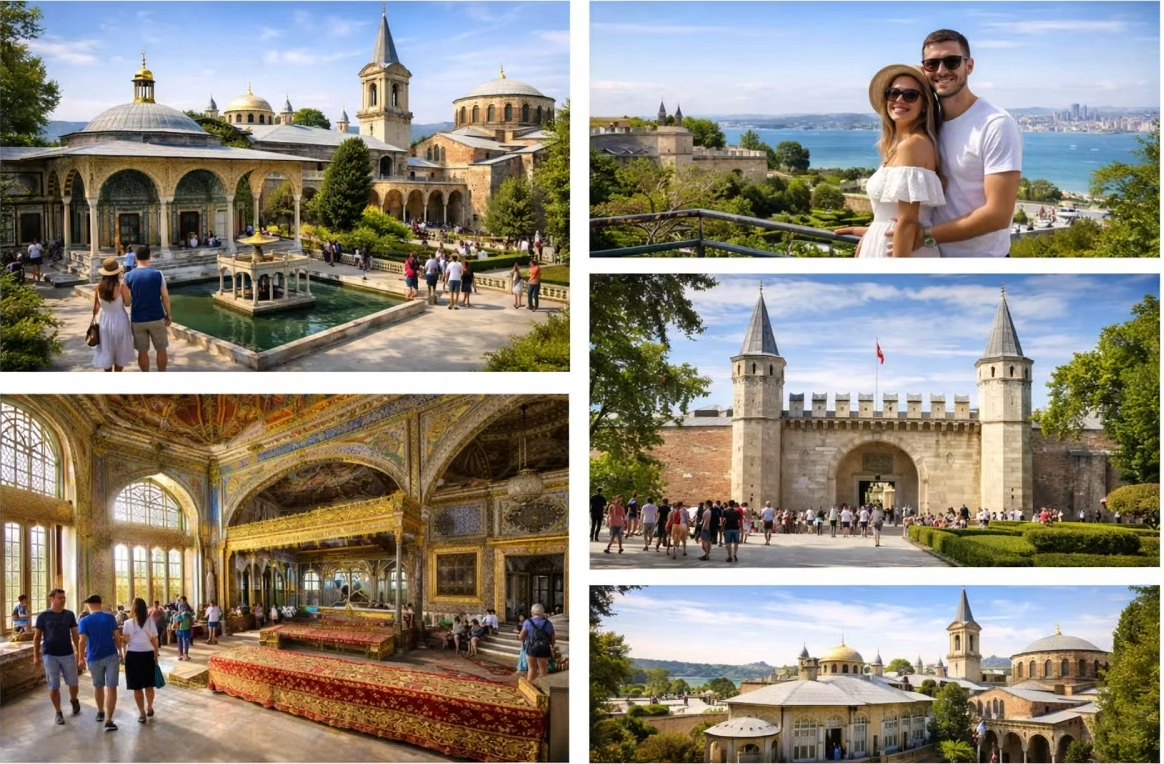
Topkapi Palace: Complete Guide to What’s Inside

Topkapi Palace is arranged around four successive courtyards. The unmissable sections are the Harem (Second Courtyard), the Imperial Treasury and Sacred Relics Room (Third Courtyard), and the Bosphorus terrace views (Fourth Courtyard). The palace kitchens, Imperial collections, and Hagia Irene round out a full visit. A thorough visit takes 3–5 hours.
Topkapi Palace is not a building — it is a city within a city. Built on the orders of Sultan Mehmed II in 1459 and expanded continuously by successive sultans over the following four centuries, the palace complex covers approximately 700,000 square metres and contains hundreds of separate rooms, pavilions, courtyards, galleries, mosques, baths, and gardens, each layer carrying its own history, artistic tradition, and political significance.
Knowing what to see and in what order before you arrive transforms your visit. This guide takes you through every significant section of the palace, explains what it contains and why it matters, and gives you an honest assessment of what is worth your time.
Understanding the Palace Layout
Topkapi Palace is organised around four courtyards arranged in a line from west to east, each more private and restricted than the last. In Ottoman times, access to each successive courtyard was permitted to fewer and fewer people — the First Courtyard was effectively public, while the Fourth was the innermost private sanctum of the sultan. Understanding this structure before you begin makes the spatial logic of the palace immediately comprehensible.
The Harem — one of the palace’s most important sections — is located within the Second Courtyard but accessed through its own separate entrance and constitutes a distinct self-contained complex. It requires dedicated time and is listed separately in this guide.
The palace is entered through the Imperial Gate (Bâb-ı Hümâyun) on the west side, and a typical visit moves eastward through the courtyards in sequence, finishing at the Fourth Courtyard terraces overlooking the Bosphorus.
First Courtyard — The Court of the Janissaries
The First Courtyard — also known as the Court of the Janissaries — is the largest and most public of the four. It was historically a semi-public space where petitioners, merchants, and soldiers could gather. Today it serves as the main transitional space between the Imperial Gate and the Gate of Salutation leading to the Second Courtyard.
The most significant building in the First Courtyard is Hagia Irene (Aya İrini) — one of the oldest surviving Byzantine churches in Istanbul, predating Hagia Sophia and dating to the 4th century AD. It is located within the palace walls but requires a separate entry ticket. Its interior is remarkably austere compared to Hagia Sophia — there are no mosaics, and the space retains its original brick construction — but it is historically significant as one of the earliest Christian places of worship to survive in Istanbul. See our dedicated Hagia Irene guide for full details.
Time to allow: 10–15 minutes (excluding Hagia Irene), 45–60 minutes if visiting Hagia Irene.
Second Courtyard — The Administrative Heart
The Second Courtyard is where the daily business of the Ottoman Empire was conducted. It is entered through the Gate of Salutation (Bâb-üs Selâm) — historically, no one except the sultan was permitted to ride a horse through this gate. The courtyard itself is a large, relatively peaceful space with cypress trees and fountains, flanked on either side by the major administrative and service buildings of the palace.
The Imperial Council Chamber (Divan-ı Hümayun)
The Divan-ı Hümayun — the Imperial Council — was the governing cabinet of the Ottoman Empire, meeting four times a week in the ornate chamber on the left side of the Second Courtyard. The Grand Vizier presided over meetings of the Divan in the sultan’s name, with the sultan himself sometimes observing unseen through a grilled window above — allowing him to monitor deliberations without being present. The chamber is richly decorated with Iznik tiles and gilded woodwork, and the adjacent Tower of Justice (Adalet Kulesi) — the tall tower visible from throughout the city — was the symbol of Ottoman law and order.
The Palace Kitchens
The palace kitchens occupy the entire right side of the Second Courtyard — a vast range of domed buildings that once produced food for up to 5,000 palace residents daily. Today they house a world-class collection of Chinese, Japanese, and European porcelain accumulated by the Ottoman court over centuries, as well as Ottoman silverware, cooking implements, and ceremonial objects. The recently renovated porcelain galleries are particularly impressive — the Chinese celadon collection alone is one of the finest outside China. See our Palace Kitchens guide for the full collection breakdown.
Time to allow for Second Courtyard (excluding Harem): 30–45 minutes.
The Harem — Power Behind the Throne
The Harem is entered through a separate gate in the Second Courtyard and constitutes one of the most historically significant and architecturally complex sections of the entire palace. It was the private residential quarters of the sultan, his mother (the Valide Sultan), his wives, concubines, children, and the black eunuchs who guarded and administered it — at its height housing several hundred people in a self-contained world of extraordinary luxury and intense political intrigue.
The Harem contains over 300 rooms, nine baths, two mosques, and numerous courtyards, halls, and private apartments — all connected by a labyrinth of corridors decorated with some of the finest Iznik tilework in existence. The most significant spaces include the Imperial Hall (Hünkâr Sofası) — a magnificent reception room where the sultan entertained — the Privy Chamber of Murad III (one of the finest rooms in the palace, with a domed ceiling and a magnificent central fountain), the Apartments of the Valide Sultan, and the Courtyard of the Concubines.
The Harem is included in the standard palace ticket since January 2024 — no additional fee applies. It is the section most visitors wish they had spent more time in, and the section most frequently underestimated. Allow at least 45–60 minutes; 75 minutes for a thorough visit.
See our dedicated Harem guide for a room-by-room breakdown.
Third Courtyard — The Sultan’s Private World
The Third Courtyard is entered through the Gate of Felicity (Bâb-üs Saâde) — the threshold beyond which only the sultan, his family, and his most trusted servants could pass. It was historically the most restricted part of the palace, containing the sultan’s private reception rooms, his treasury, and the sacred relics of the Islamic caliphate.
The Audience Chamber (Arz Odası)
Directly inside the Gate of Felicity stands the Audience Chamber — the room where the sultan received foreign ambassadors and granted official audiences. It is a relatively small, exquisitely decorated pavilion whose scale surprises visitors expecting a grand throne room. The deliberate intimacy was intentional — foreign envoys were brought before the sultan in a controlled, measured setting designed to awe without overwhelming.
The Imperial Treasury
The Imperial Treasury is the single most visited section of the palace and one of the great treasure collections of the world. Spread across four rooms, it contains an extraordinary accumulation of jewelled objects, ceremonial weapons, thrones, robes of honour, and decorative arts assembled by the Ottoman sultans over five centuries.
The highlights are iconic: the Topkapi Dagger — a ceremonial dagger with a hilt set with three enormous emeralds, considered one of the finest examples of Ottoman goldsmithing — and the Spoonmaker’s Diamond (Kaşıkçı Elması), an 86-carat pear-shaped diamond that is one of the largest on public display anywhere in the world, surrounded by 49 smaller diamonds in a double row setting. The Treasury also contains the Throne of Shah Ismail, jewel-encrusted armour, the famous emerald pendant, and thousands of other objects of extraordinary craftsmanship. Allow 35–45 minutes.
See our Imperial Treasury guide for a detailed room-by-room breakdown.
The Sacred Relics Room (Kutsal Emanetler Odası)
The Sacred Relics Room is one of the most significant Islamic heritage sites in the world and is treated by many of its visitors with the reverence of an active shrine. It houses relics associated with the Prophet Muhammad and the early caliphs — including the Khirqa-i Sharif (the Prophet’s mantle), his sword, his seal, strands of his beard, a cast of his footprint, and a letter written in his hand — as well as the sword of the Caliph Umar, the staff of the Prophet Moses, and relics of the Prophet Abraham.
These objects came to the palace following the Ottoman conquest of Egypt in 1517, when Sultan Selim I assumed the title of Caliph and transferred the sacred relics of Islam to Istanbul. They have been housed in Topkapi ever since, tended continuously by designated palace attendants who recite verses from the Quran in the chamber around the clock — a practice that continues to this day.
Photography is restricted inside the inner chamber. The atmosphere is unlike anywhere else in the palace — hushed, deeply reverential, and moving for visitors of all backgrounds. Allow 20–30 minutes. See our Sacred Relics Room guide for more.
The Imperial Collections
The Third Courtyard also contains galleries displaying the Ottoman miniature paintings, manuscripts, and calligraphic works accumulated by the palace library, as well as the Imperial wardrobe collection — caftans, robes, and garments worn by the sultans across five centuries, a remarkable record of Ottoman textile art and court fashion. See our Imperial Collections guide for details.
Time to allow for Third Courtyard in total: 60–90 minutes.
Fourth Courtyard — Gardens, Kiosks & the Bosphorus
The Fourth Courtyard is the innermost and most private section of the palace — historically reserved exclusively for the sultan and his immediate household. Today it is one of the most beautiful and serene spaces in Istanbul, a series of terraced gardens and elegant kiosks looking out over one of the world’s great natural waterways.
The main terrace of the Fourth Courtyard provides a panoramic view over the Bosphorus Strait, the Sea of Marmara, and the Asian shore of Istanbul — a view that the sultans of the Ottoman Empire surveyed from this exact point for four hundred years. The light in late afternoon is extraordinary. See our full Bosphorus views guide for the best photo spots and timing advice.
The courtyard also contains several Ottoman kiosks and pavilions of great beauty: the Baghdad Kiosk, built by Murad IV in 1639 to celebrate the conquest of Baghdad, is considered one of the finest examples of Ottoman classical architecture in the palace; the Circumcision Room (Sünnet Odası) is covered internally with some of the most beautiful Iznik tile panels in existence; and the İftariye Kiosk — a gilded open canopy at the edge of the terrace — provided the sultan with a ceremonial space for breaking the fast during Ramadan, directly above the Golden Horn.
Time to allow: 20–30 minutes.
What to Prioritise If Your Time Is Limited
If you have under 3 hours at Topkapi Palace, this is the order of priority:
- The Harem — enter immediately on arrival in the Second Courtyard; most time-sensitive due to crowd build-up
- Imperial Treasury — the Topkapi Dagger and Spoonmaker’s Diamond
- Sacred Relics Room — one of the most significant Islamic heritage collections in the world
- Fourth Courtyard terraces — the Bosphorus panorama is unmissable
The Palace Kitchens, Audience Chamber, Imperial Collections, and Hagia Irene are secondary priorities for visitors with more time. See our how long to spend guide for full itineraries by time available.
Frequently Asked Questions
What is the most famous thing at Topkapi Palace?
The Topkapi Dagger and the Spoonmaker’s Diamond in the Imperial Treasury are the most internationally famous objects. The Sacred Relics Room is the most significant from a historical and religious standpoint. The Harem is what most visitors find most memorable.
Is the Harem worth visiting?
Absolutely. The Harem is one of the most misunderstood and underestimated sections of any major museum in the world. Far from being merely a private residence, it was a sophisticated and often turbulent political environment where the Valide Sultan and other royal women wielded genuine influence over succession and state affairs. The architecture, tilework, and historical depth make it the most rewarding section of the palace for many visitors.
Do you need a guide to appreciate Topkapi Palace?
A guide is not essential but significantly enriches the experience. The palace’s historical depth — five centuries of Ottoman history compressed into hundreds of rooms — rewards contextual knowledge. The audio guide app in up to 25 languages is a strong independent alternative. See our audio guide vs guided tour comparison.
What is the Topkapi Dagger?
The Topkapi Dagger is a ceremonial Ottoman dagger with a hilt set with three enormous emeralds and encrusted with diamonds. It is housed in the Imperial Treasury and was made in 1747. It became internationally famous after the 1964 heist film “Topkapi,” which was based on a fictional plot to steal it. See our Imperial Treasury guide for full details.
